
Retire the hardware, not the risk on it.
When equipment comes out of service, the data, the compliance exposure, and the environmental liability do not leave with it — unless someone owns the disposal end to end. We do, on the same chain of custody that pulled the gear.
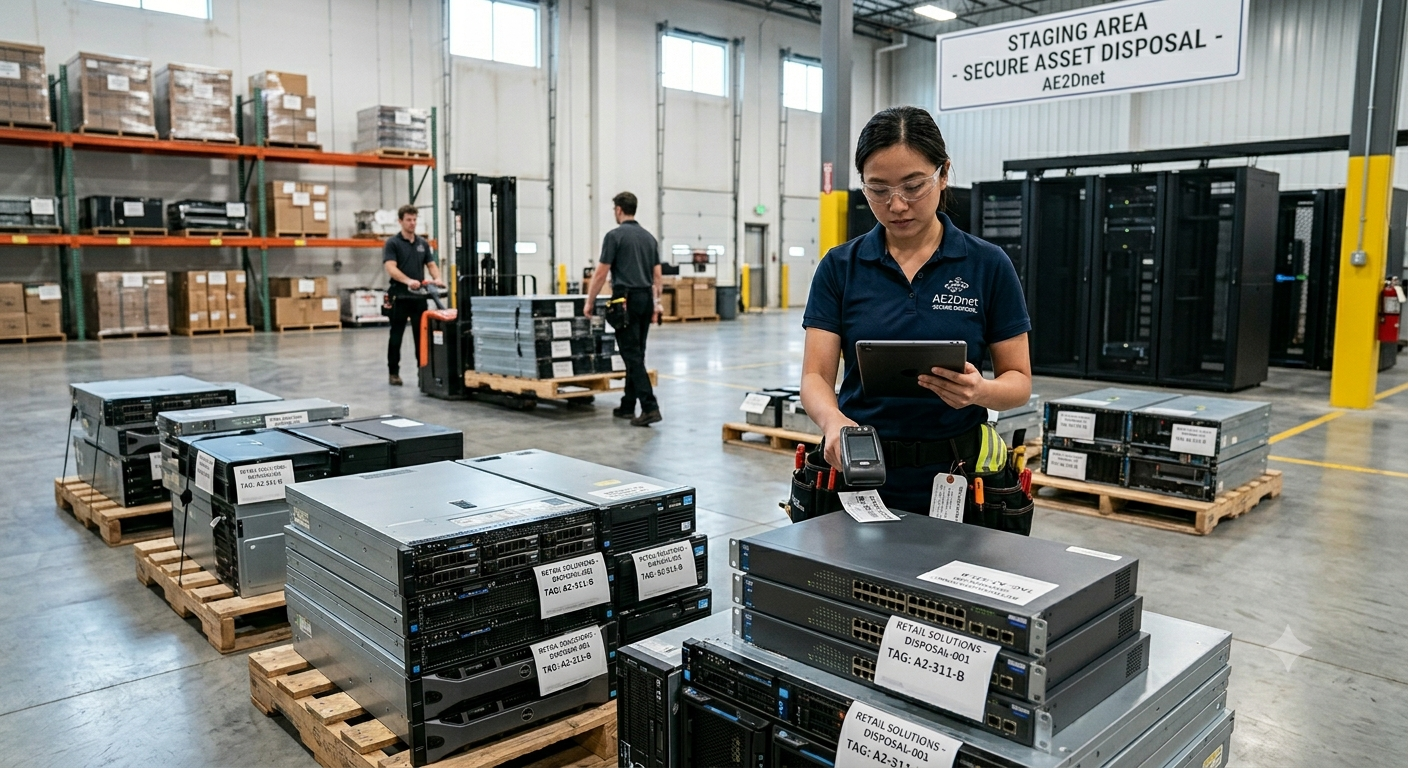
Every server, switch, drive, and POS terminal that comes out of service is still carrying something when it leaves the rack — data, a compliance obligation, and a disposal liability. AE2Dnet handles the back end of the asset lifecycle the same way we handle the front: as one accountable chain, from the moment the equipment is pulled to the certificate that proves it was destroyed.
Disposal is a security problem, not a logistics one
A retired drive is not empty just because it is unplugged. Decommissioned equipment is one of the most common sources of data exposure, precisely because it falls between teams — IT pulls it, it gets stacked in a closet, and months later it walks out a loading dock with records still readable.
The risk is not the disposal itself; it is the gap before it. Closing that gap means custody is never handed to a party who is not accountable for what is on the media. Because the same organization that decommissions your network also disposes of it, that gap never opens.
One unbroken chain of custody
- Inventory and asset tagging. Every unit is logged by serial and asset tag at pickup, so the count that leaves your site is the exact count that gets destroyed and certified.
- Secure transport. Sealed, tracked movement from your site to the processing facility — no unaccounted stops, no custody handed to anyone outside the chain.
- Data sanitization. Media is wiped, degaussed, or shredded to the NIST 800-88 standard appropriate to its sensitivity, before anything is resold or recycled.
- Recycle or remarket. Assets with remaining value are remarketed for recovery; everything else is broken down through certified downstream recyclers.
- Certificates. You receive a certificate of data destruction and a certificate of recycling, each traceable back to the serials captured in step one.
Data destruction, to the NIST 800-88 standard
| Method | What happens | When we use it |
|---|---|---|
| Clear | Verified software overwrite; the drive stays usable afterward. | Assets being remarketed or redeployed inside your fleet. |
| Purge | Degaussing or cryptographic erase renders the data unrecoverable. | Higher-sensitivity media and self-encrypting drives. |
| Destroy | Physical shredding or disintegration of the media itself. | Highest-sensitivity data, and any drive past reuse. |
Certified, documented, audit-ready
Disposal that is not documented did not happen, as far as an auditor is concerned. Every engagement closes with a certificate of data destruction and a certificate of recycling, traceable to the asset serials logged at pickup. Downstream processing flows through R2v3- and e-Stewards-certified recyclers, and the paperwork is built to support records obligations under HIPAA, FACTA, Sarbanes-Oxley, and GLBA.
Value recovery, not just disposal
Not everything that comes out of service is at end of life. Where equipment still carries market value, remarketing it offsets the cost of disposal — sometimes turning a line item into a credit. You keep the recovered value; we handle the wiping, testing, and resale.
What we take out of service
- Servers and storage arrays
- Switches, routers, and firewalls
- Hard drives and SSDs
- POS terminals and pin pads
- UPS and power equipment
- Workstations and laptops
- Telecom and cabling hardware
- Network appliances and NVRs
Have a build in mind? Let’s scope it.
Tell us the route, the sites, or the problem. An engineer — not a sales rep — will get back to you.