
Copper, fiber, and the right one for the run.
The physical layer everything else rides on. Here is how the media differ, what belongs at each location, and which connectors do what — so the cable in the wall is never the thing holding the network back.
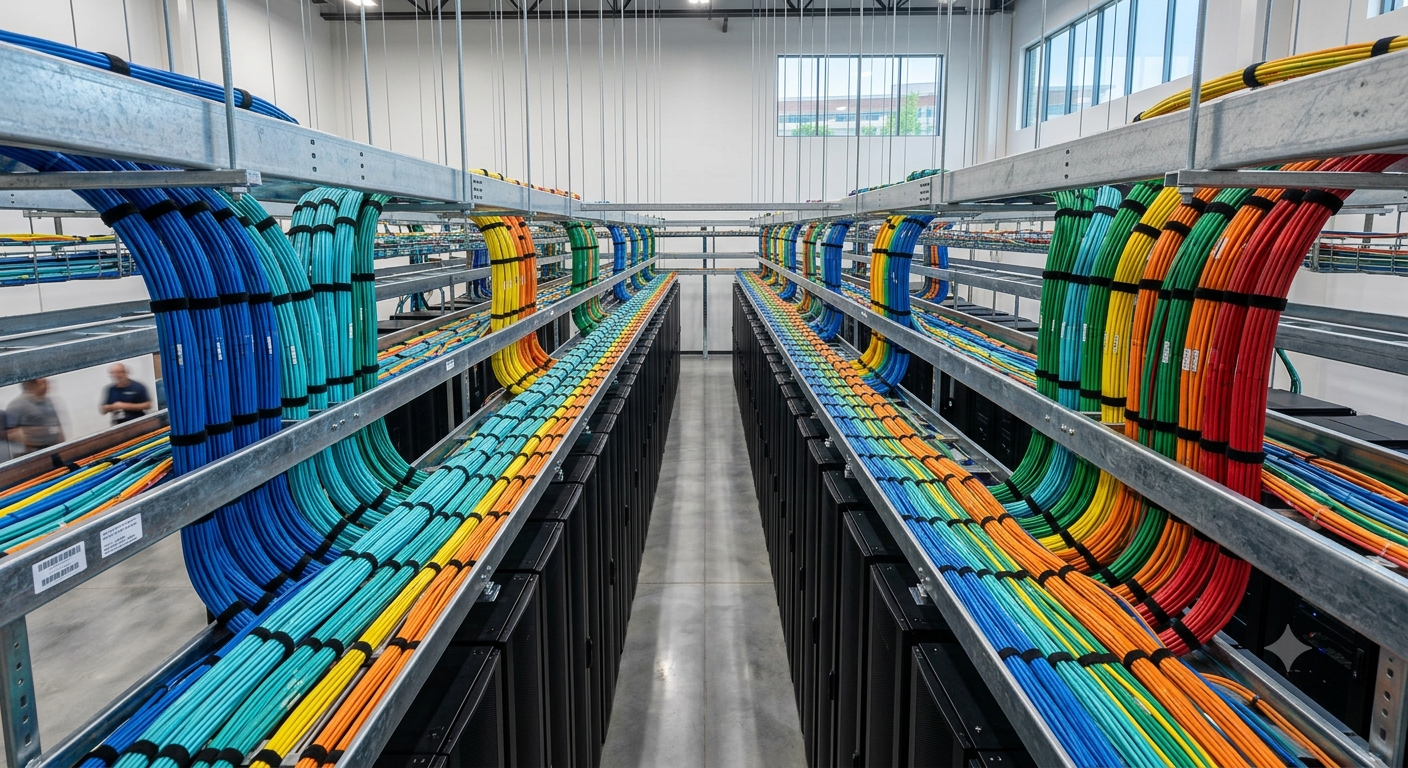
Every megabit, every camera feed, every transaction rides on the physical layer — and the medium you choose at each point decides how fast the network is today and how long before you have to tear it open again. Copper or fiber, Cat6A or single-mode, RJ45 or LC: the right answer shifts with distance, bandwidth, and where in the building you are.
Copper: twisted pair
Twisted-pair copper carries the last stretch to the device. The category is really a question of how much bandwidth you want to still have headroom for in five years — the cable is cheap, but the labor to pull it again is not.
| Category | Max rate | Bandwidth | Distance | Best for |
|---|---|---|---|---|
| Cat5e | 1 Gbps | 100 MHz | 100 m | Legacy horizontal and voice; phased out for new data runs. |
| Cat6 | 1 Gbps (10G to ~55 m) | 250 MHz | 100 m | Office desks and light data runs. |
| Cat6A | 10 Gbps | 500 MHz | 100 m | The modern horizontal standard — PoE, Wi-Fi APs, cameras. |
| Cat7 / 7A | 10 Gbps | 600–1000 MHz | 100 m | Shielded niche; non-standard connectors, largely superseded. |
| Cat8 | 25–40 Gbps | 2000 MHz | 30 m | Data-center top-of-rack, switch-to-server. |
Where copper goes next
There is no Cat9, and there will not be — Cat8 is where twisted-pair tops out, and higher speeds over distance move to fiber. But copper is not standing still: the next generation is about doing more with the cable already in the wall, reaching places fiber does not go, and carrying power as well as data.
| Technology | What it is | Why it matters |
|---|---|---|
| Multi-gig (NBASE-T) | 2.5G and 5G Ethernet over existing Cat5e / Cat6. | Feeds Wi-Fi 6/7 APs past 1G without re-cabling. |
| Single Pair Ethernet | Ethernet over one pair; 10BASE-T1L reaches ~1 km. | IoT, building automation, and sensors where Cat6A is overkill. |
| PoE++ (802.3bt) | Up to ~90 W of power over the same data cable. | Powers APs, cameras, and displays with no separate electrical drop. |
Fiber: multimode and single-mode
Fiber splits cleanly into two jobs. Multimode (the OM grades) is cheaper to terminate and is built for high bandwidth over short reach — inside a building or a data center. Single-mode (OS2) is the distance medium: campus, metro, long-haul, and every foot of carrier transport.
| Type | Mode | Reach | Best for |
|---|---|---|---|
| OM3 | Multimode (50 µm) | 10G to ~300 m; 100G to ~70 m | In-building and data-center short reach. |
| OM4 | Multimode (50 µm) | 10G to ~400 m; 100G to ~150 m | Data-center backbone and risers. |
| OM5 | Multimode, wideband | Adds SWDM for more lanes per fiber | High-density data center. |
| OS2 | Single-mode (9 µm) | 10G+ over tens of kilometers | Campus, metro, long-haul, carrier transport. |
What to use, where
There is no single best cable — only the right one for the run. The same building will use Cat6A to the desk, multimode in the riser, and single-mode out to the street.
| Location | Use | Why |
|---|---|---|
| Desk and general horizontal | Cat6A | Headroom for PoE and multi-gig Wi-Fi; one standard to maintain. |
| Wi-Fi APs, cameras, PoE devices | Cat6A | Handles PoE heat and bandwidth without re-cabling later. |
| Building / riser backbone | OM4 fiber | High bandwidth between floors with distance to spare. |
| Data center, switch to server | Cat8 or DAC | 25–40G over the short rack distances where copper still wins. |
| Data center spine, cross-connect | OM4 / OM5 | Density and bandwidth for 40/100G over MPO trunks. |
| Building to building, campus | OS2 single-mode | Distance and headroom beyond multimode limits. |
| Metro, long-haul, outside plant | OS2 single-mode | The only medium that carries carrier distances. |
Connectors and their roles
The connector is dictated by the medium and the equipment it plugs into. Get the medium and the distance right first; the connector follows from the optics and the panel.
| Connector | Medium | Role |
|---|---|---|
| RJ45 (8P8C) | Copper twisted pair | The universal Ethernet jack — desks, patch panels, equipment. |
| LC | Fiber, duplex small-form | The dominant connector on modern switches, routers, and SFP optics. |
| SC | Fiber, push-pull | Enterprise and carrier equipment; common on older active gear. |
| ST | Fiber, bayonet | Legacy multimode and older building installs. |
| MPO / MTP | Fiber, multi-fiber ribbon | High-density data-center trunks and 40/100G breakouts. |
| Keystone / 110 punchdown | Copper termination | Where horizontal cable lands in jacks and patch panels. |
How we build it
- Install and certify to the TIA-568 standard — tested, documented, and labeled.
- Copper for the last hundred meters; fiber for distance and density.
- Spec one category above today’s need — re-cabling is the expensive part, not the cable.
- Match the connector to the equipment, not the other way around.
Have a build in mind? Let’s scope it.
Tell us the route, the sites, or the problem. An engineer — not a sales rep — will get back to you.