
Point of sale, deployed to keep your scope small.
Install, replace, or service POS lanes, self-checkout, and kiosks across retail, pharmacy, and QSR — deployed by a team that understands every lane carries PCI scope, and builds to shrink it.
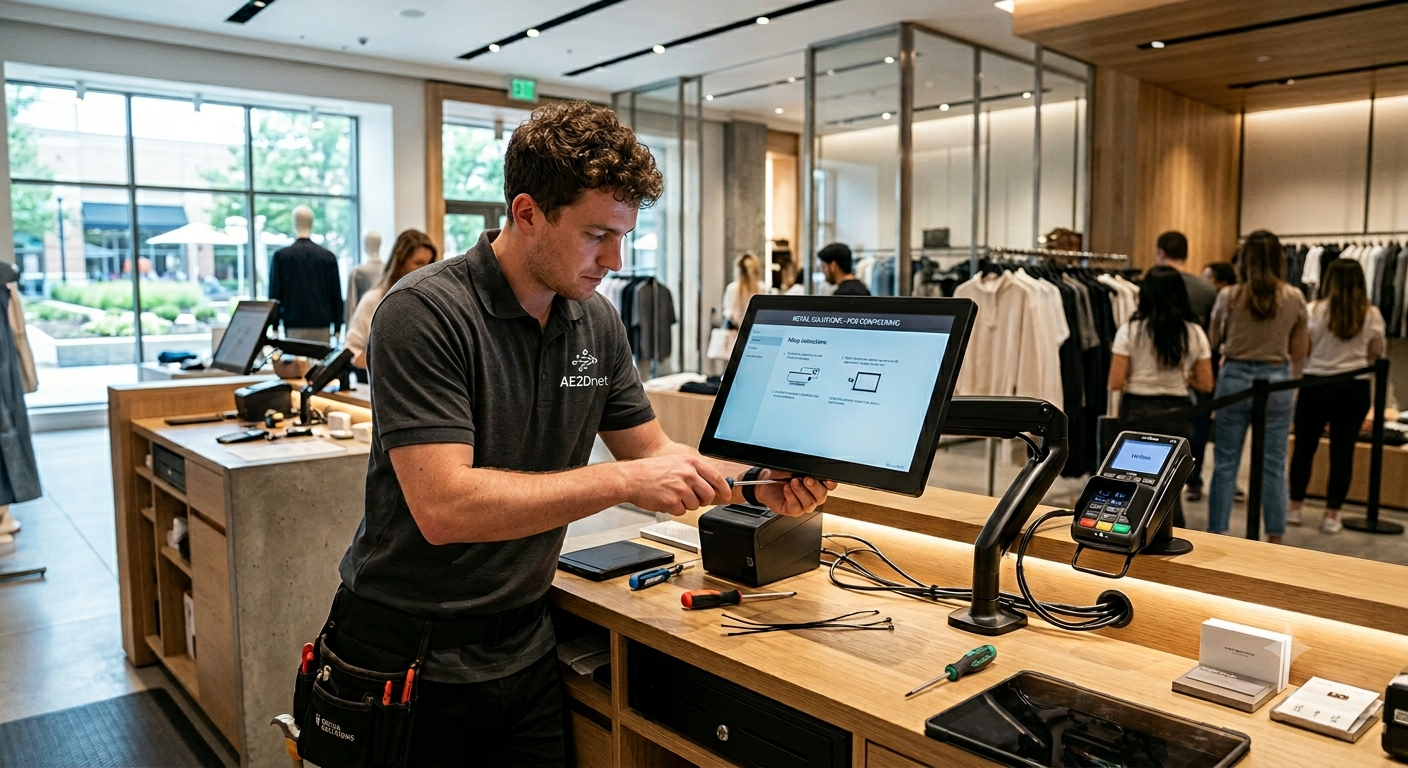
A point-of-sale lane is never just hardware. The moment a device touches cardholder data, it pulls PCI DSS scope onto everything around it — the network it sits on, the systems it talks to, the people who can reach it. We deploy and integrate POS, self-checkout, and kiosks so the install works with your compliance posture instead of quietly expanding it.
PCI scope follows the wiring
How a lane is networked decides how much of your environment falls inside the cardholder data environment, or CDE. Drop POS onto a flat network and everything that can reach it is in scope; segment it properly and the CDE — and the audit that follows it — stays small.
Because the same crew runs your structured cabling and installs the terminals, that segmentation is designed in from the first drop, not retrofitted after an assessor flags it. The wiring and the compliance boundary are decided together, by one team.
A deployment built around scope reduction
- Stage and image. Devices are configured, encryption keys injected, and tested before they ever reach the sales floor.
- Segmented network drop. Lanes land on an isolated segment for the cardholder data environment — not the general store network.
- Encrypted at the reader. P2PE or an equivalent so cardholder data is encrypted inside the device, before it enters your network.
- Validate and test. Every lane is transaction-tested and the segmentation is verified before sign-off.
- Document. As-builts, device inventory, and the network boundary are handed over for your assessor.
The technologies that shrink your PCI footprint
| Technology | What it does | Effect on PCI scope |
|---|---|---|
| EMV (chip) | Authenticates the card at the terminal. | Shifts counterfeit-fraud liability; a baseline expectation, not a scope reducer on its own. |
| P2PE | Encrypts card data inside the reader, before it touches the merchant network. | The biggest scope reducer — a validated P2PE solution can move a merchant to the much shorter SAQ P2PE. |
| Tokenization | Replaces the stored card number with a meaningless token. | Removes systems that would otherwise store cardholder data from scope. |
| Segmentation | Isolates the cardholder data environment from the rest of the network. | Keeps everything outside the segment out of scope entirely. |
Validation, not just installation
PCI validation depends on how cards are processed, and the lighter paths are only available if the deployment supports them. A validated P2PE deployment can move a merchant to SAQ P2PE — a fraction of the questions of a full SAQ D. We deploy toward the lightest defensible validation path for your environment and hand your QSA or acquirer the documentation to back it up. We install and integrate; your assessor validates — our job is to make theirs short.
What we deploy and service
- POS lane install, refresh, and break/fix
- Self-checkout and kiosks
- PIN-pad replacement and EMV upgrades
- P2PE-validated device deployment
- Segmented cabling and power for lanes
- Imaging, staging, and key injection
- Back-office and controller integration
- Moves, adds, and changes at scale
Have a build in mind? Let’s scope it.
Tell us the route, the sites, or the problem. An engineer — not a sales rep — will get back to you.